

What Does “No Restrictions” Mean When Buying Land?

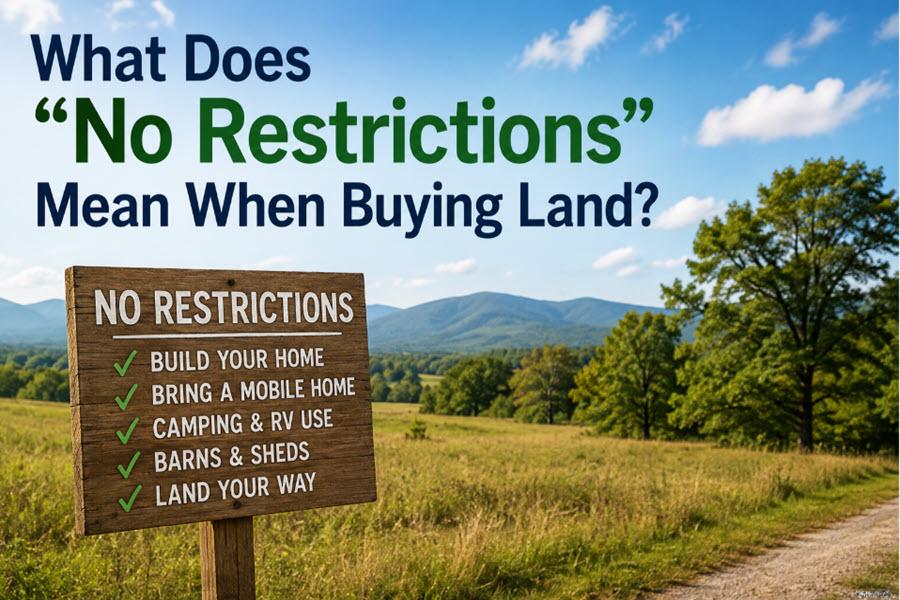
The phrase “no restrictions” can sound very appealing when you are shopping for vacant land. It may bring to mind complete freedom—the ability to build whatever you want, park an RV, place a mobile home, start a small homestead, or simply hold the property for the future.
However, “no restrictions” does not always mean there are absolutely no rules.
This is one of the most important things land buyers should understand before purchasing a property. A listing may advertise land as having “no restrictions” because there is no HOA, no known deed restrictions, or no private subdivision rules. But the property may still be subject to county zoning, building codes, environmental regulations, septic requirements, floodplain rules, access requirements, and other government regulations.
Before buying any property, it is important to understand exactly what the phrase means—and what questions you should ask before making your purchase.
Why “No Restrictions” Does Not Mean “No Rules”
In a land listing, the phrase “no restrictions” usually refers to the absence of certain private restrictions on the property. For example, there may be no known homeowners association, no subdivision rules, or no recorded deed restrictions limiting how the property can be used.
That can give a buyer much more flexibility than a property located in a heavily regulated subdivision. However, private restrictions and government regulations are two different things.
A property may have no HOA and no deed restrictions but still be subject to:
- County or city zoning
- Building permit requirements
- Setback requirements
- Septic or sewer regulations
- Well permits or water rules
- Floodplain regulations
- Environmental regulations
- Road access requirements
- Easements
- Minimum building standards
For this reason, a buyer should never assume that “no restrictions” automatically means, “I can do anything I want with this land.”
At MrLandSeller.com, we encourage buyers to review the information provided for each property and independently verify any use that is important to them before purchasing. Our FAQ also explains that whether a buyer can build or use a property in a particular way can depend on local zoning, access, utilities, and permitting requirements.
Understanding Private Restrictions
Private restrictions are limitations created through documents connected to the property. These may include deed restrictions, restrictive covenants, subdivision rules, or HOA regulations.
For example, a restricted subdivision may have rules stating:
- Only site-built homes are allowed.
- Mobile or manufactured homes are prohibited.
- Homes must meet a minimum square footage requirement.
- Commercial businesses are not allowed.
- RVs cannot be used as permanent residences.
- Certain animals or livestock are prohibited.
- Buildings must meet specific architectural requirements.
When a property is described as having “no restrictions,” it may mean that these types of private rules do not apply, or that the seller has found no known restrictions affecting the parcel.
That can be a major advantage for buyers who want flexibility.
Imagine two similar properties. One is located in a subdivision with an HOA that requires a minimum 2,000-square-foot site-built home. The other has no HOA and no known deed restrictions. The second property may offer more freedom—but the buyer still needs to check with the local government before assuming a tiny home, manufactured home, RV, or other use is allowed.
Zoning Can Still Apply
One of the first things buyers should investigate is zoning.
Zoning is generally established by local governments to regulate land use. Depending on the location, zoning may determine whether land can be used for residential, agricultural, commercial, industrial, recreational, or other purposes.
A parcel described as unrestricted could still be zoned residential. That zoning classification could affect:
- The type of home you can build
- Whether a manufactured home is allowed
- Whether you can operate a business
- Whether livestock is permitted
- How many structures can be built
- Required setbacks from property lines
- Minimum lot size requirements
- Whether permits are required before construction
Some rural properties may have little or no traditional zoning, while others may be located in areas with detailed land-use regulations.
The important point is simple: always contact the appropriate county or local planning and zoning department and explain exactly how you plan to use the property.
Do not simply ask, “Is the property unrestricted?”
Instead, ask specific questions.
For example:
“Can I place a manufactured home on this parcel?”
“Can I build a 900-square-foot home?”
“Can I park and use an RV on the property?”
“Can I use this property for recreational camping?”
“Are there any minimum square footage requirements?”
“What permits would I need before building?”
Specific questions are much more likely to give you information that is useful for your particular plans.

“No Restrictions” and Mobile or Manufactured Homes
This is one of the most common areas of confusion for land buyers.
A buyer may see “no restrictions” in a listing and assume that they can immediately place a mobile home or manufactured home on the property.
That may not always be the case.
Even without private deed restrictions, a county, municipality, or other local authority may have regulations governing manufactured housing. Requirements can vary significantly depending on the location.
Before purchasing land for a manufactured home, ask the local authorities:
- Are manufactured homes allowed?
- Are mobile homes allowed?
- Is there an age requirement?
- Are single-wide homes permitted?
- Is a permanent foundation required?
- Is a building or placement permit required?
- Are there minimum size requirements?
- Are utility connections required before occupancy?
The same idea applies to tiny homes, container homes, cabins, and other alternative housing options.
Never assume that one property is suitable for your plans simply because another unrestricted property in the same county allowed a similar use.
Rules can sometimes differ based on zoning, location, subdivision status, road access, parcel size, or other factors.
Utilities Are a Separate Issue
Another common misunderstanding is believing that unrestricted land automatically has everything needed to build or live on the property.
“No restrictions” does not mean:
- Electricity is available
- Water is available
- Sewer is available
- A well can automatically be drilled
- Septic will automatically be approved
- Internet service is available
A beautiful unrestricted parcel may still be raw land.
Before purchasing, find out:
- Where is the nearest power source?
- Is public water available?
- Is sewer available?
- If not, can the property support a septic system?
- Is a well permitted or practical in the area?
- What will it cost to bring utilities to the property?
If a property requires a septic system, buyers should investigate the local requirements before committing to a construction plan. The U.S. Environmental Protection Agency’s septic system resources provide useful information for property owners and buyers about septic systems and the importance of understanding and maintaining them.
In many areas, the ability to install a septic system can be extremely important. Soil conditions, lot size, groundwater, and local health department requirements may all affect what is possible.
Check for Easements and Access
Owning land does not always guarantee that access is as simple as it appears on a map.
Some parcels have direct access to a public road. Others may depend on a private road or an easement across another property.
An easement is a legal right allowing someone to use part of another person’s property for a specific purpose. For example, an access easement may allow a landowner to travel across neighboring land to reach their property.
There may also be utility easements allowing power, water, pipelines, or other infrastructure to cross a parcel.
Before purchasing land, ask:
- Does the property have legal access?
- Is the access road public or private?
- Is there a recorded easement?
- Who maintains the road?
- Can the road be used year-round?
- Are there gates or other limitations?
Physical access and legal access are not always the same thing. A dirt road may appear to lead directly to a property, but buyers should verify the legal right to use that road.
A title company, attorney, survey, county records, and recorded property documents may help clarify these issues.
Flood Zones and Environmental Factors
Even unrestricted land may be located in a flood zone or an environmentally sensitive area.
Flood risk can affect where and how you build, insurance requirements, construction costs, and the overall use of the property.
Before buying, consider checking the property’s flood information through the FEMA Flood Map Service Center and flood mapping tools. FEMA identifies the Map Service Center as the official source for National Flood Insurance Program flood hazard information.
Being in or near a flood zone does not necessarily mean that land is unusable. However, it may affect your plans and should be researched before purchasing.
Other environmental factors may include wetlands, protected habitats, drainage areas, steep slopes, and soil conditions.
Topography can also be important. A property with dramatic views may have steep terrain that makes construction more difficult or expensive. The U.S. Geological Survey’s topographic mapping resources explain how contour lines show elevation and the shape and steepness of terrain.
No HOA Can Be a Major Advantage
For many buyers, one of the biggest benefits of unrestricted land is the possibility of having no homeowners association.
HOAs can establish rules about:
- The appearance of buildings
- Fences
- Parking
- RVs
- Storage buildings
- Landscaping
- Home design
- Property maintenance
If a property truly has no HOA, the owner may avoid those particular private rules and recurring HOA fees.
However, no HOA does not eliminate local laws.
For example, you may not have an HOA telling you what color to paint your house, but you may still need to obtain permits, follow setback rules, and comply with local building requirements.
This distinction is important:
No HOA = fewer private rules.
No restrictions = potentially fewer private limitations.
Neither phrase automatically means there are no government regulations.
The Best Questions to Ask Before Buying Unrestricted Land
Before purchasing any property advertised as unrestricted or having no restrictions, make a list of exactly how you want to use it.
Then contact the appropriate local offices and ask questions related to your specific plans.
Here is a useful checklist:
1. What is the property’s zoning?
Ask for the exact zoning classification and what uses are permitted.
2. Can I build the type of structure I want?
Whether you plan to build a traditional home, cabin, tiny home, manufactured home, or another structure, verify it directly.
3. Are there any minimum building size requirements?
Some areas may have minimum square footage or other construction standards.
4. Can I use an RV or camp on the property?
Rules regarding temporary or permanent RV use can vary significantly.
5. Are utilities available?
Verify electricity, water, sewer, internet, and other services directly with the appropriate providers.
6. Can the property support a septic system?
Contact the local health department or appropriate authority to understand the requirements.
7. Does the property have legal access?
Review recorded access, easements, and the status of any roads leading to the property.
8. Is the property in a flood zone?
Review FEMA information and ask local officials about any applicable building requirements.
9. Are there recorded restrictions or covenants?
Review the deed, title information, and other recorded documents.
10. What permits will I need?
Find out what approvals may be required before building, placing a home, installing utilities, or beginning other improvements.
Do Your Due Diligence Before Closing
The best land purchase is one where the buyer understands the property before closing.
Land can be an exciting investment and can offer opportunities for building, recreation, camping, homesteading, or long-term ownership. But every parcel is different.
At MrLandSeller.com, property listings may provide information such as zoning, known utility availability, road access, parcel boundaries, and restrictions when available. The information should be used as a starting point for your research—not as a replacement for verifying the details that matter most to your intended use.
For example, some properties on the site are marketed as having no restrictions or no particular zoning, while still recommending that buyers verify their intended use and applicable regulations with the county.
This is especially important if you are purchasing land for a specific purpose. If your entire plan depends on placing a manufactured home, building a cabin, living in an RV, raising animals, or starting a business, confirm that use before you buy.
Final Thoughts: Freedom Comes With Responsibility
Unrestricted land can be an excellent opportunity for buyers looking for flexibility and fewer private limitations.
You may have more freedom to design your property, choose the type of structure you want, use the land recreationally, or simply hold it for the future.
But the phrase “no restrictions” should always be understood in context.
It may mean there is no HOA. It may mean there are no known deed restrictions. It may mean there are fewer private rules than you would find in a traditional subdivision.
It does not automatically guarantee that every possible use is allowed.
Before purchasing, take the time to research zoning, permits, utilities, septic requirements, access, easements, flood risk, and any other factors related to your plans.
A few phone calls and some careful due diligence before closing can help prevent expensive surprises later.
If you are looking for vacant land for a future home, recreation, investment, or another purpose, explore the available properties at MrLandSeller.com. Each property is unique, so be sure to review the listing details and verify any intended use with the appropriate local authorities before making your final decision.
Disclaimer: This article is provided for general informational purposes only and is not legal, engineering, zoning, environmental, or financial advice. Land-use regulations and property conditions vary by location and can change over time. Buyers should independently verify all information important to their intended use with the appropriate county, city, utility provider, health department, title company, attorney, surveyor, or other qualified professional before purchasing land.
Ready to invest in the future of land ownership?
👉 Join our exclusive buyer list to get first access to discounted land deals — before they go public.
Or browse available properties now and secure your next investment today.
